
Replacements, widening & pads
Concrete Driveways in Baton Rouge, LA
A firm base, the right thickness and a slope that sends Louisiana rain where it belongs.
- Free measuring visit at your property
- Written quote with each line priced
- Grade and drainage planned before forms go in
Driveways That Hold Up to Rain and Clay
Concrete driveways in Baton Rouge rarely wear out from the top. They fail from underneath. The city averages 61.94 inches of rain a year, often in short, hard storms, and every gallon that runs along a driveway edge or under a joint softens the soil that holds the slab up. Add clay that swells in wet months and shrinks in dry ones, plus the roots of a live oak in the front yard, and you get the familiar pattern: cracked corners, a panel that dropped at the garage door, and edges that crumble into the lawn.
Signs a driveway is due for replacement
- Cracks wide enough to catch a coin, or with one side higher than the other
- Panels that rock when you drive over them
- Water that stands at the garage door or flows toward the house
- Broken edges and corners along the grass
- A surface worn down to loose stone
- A layout too narrow for the vehicles you own now
One sunken panel on an otherwise sound slab can often be lifted instead, and that option is covered on our repair page. When cracking, settling and drainage problems show up together, a new driveway on a proper base is usually the better spend.
What goes under the slab
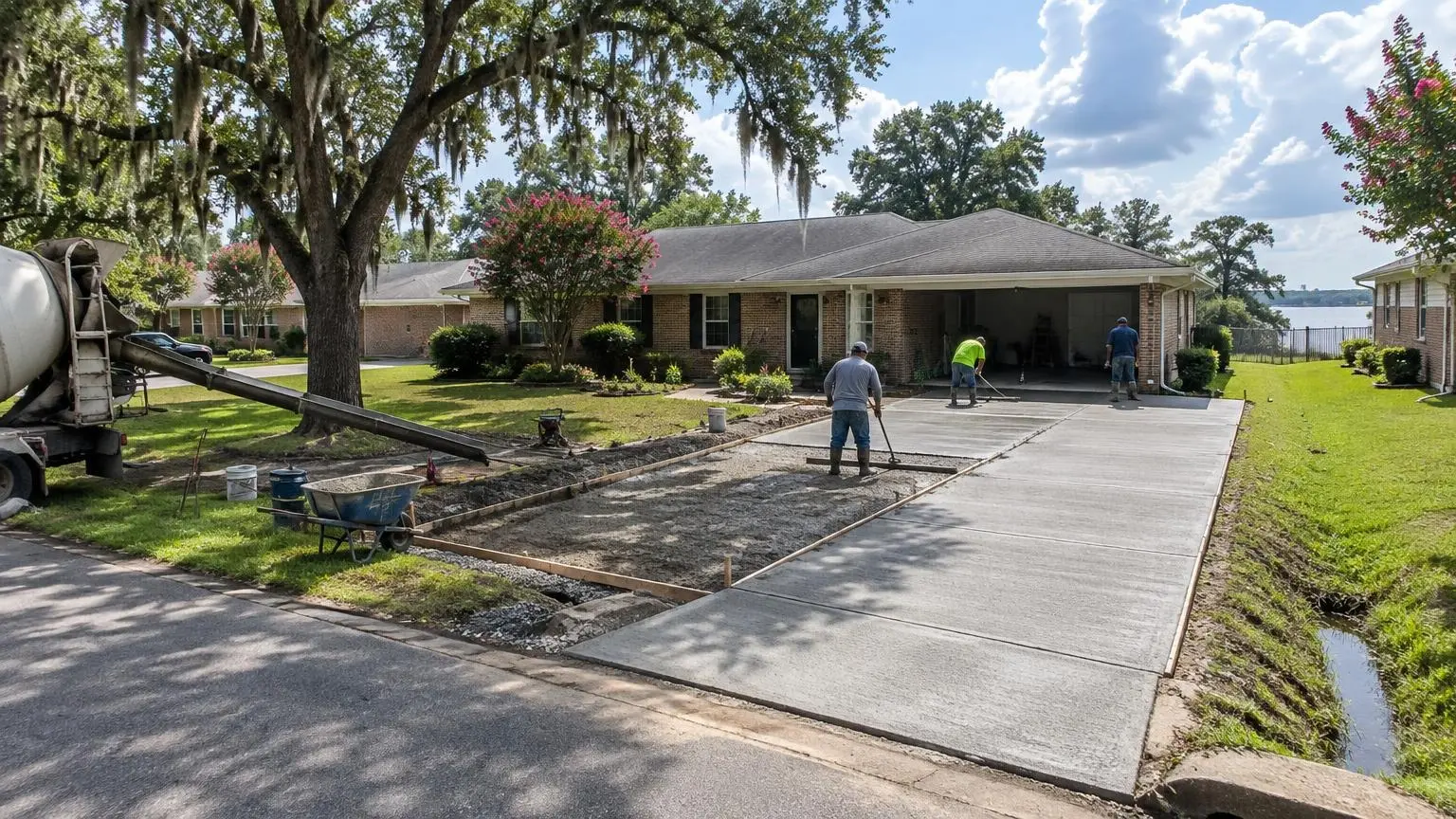
We break out and haul away the old concrete, asphalt or gravel, then dig out soft, wet or organic soil until we reach firm ground. A base is placed and compacted in layers, giving the new slab even support and a path for water to drain. Forms are set so the finished surface falls toward the street or ditch and away from the garage slab and foundation.
Thickness follows the load. HomeGuide's driveway guide recommends at least 4 inches for passenger vehicles, 5 to 6 inches for RVs or heavy trucks, and edges of 6 to 8 inches. If a work truck, a boat trailer or a camper parks on the drive, we thicken that area. Rebar or wire set in the middle of the slab holds cracked sections together, and saw-cut joints on a planned grid give shrinkage cracks a straight, intended path.
Keeping water off the edges
In clay soil, the edge of the slab is the weak spot. We look at where your downspouts empty, how the lawn slopes toward the drive, and whether a neighbor's runoff crosses your lot. Sometimes the fix is as simple as extending a downspout past the slab or regrading a strip of yard so water moves away from the concrete instead of soaking under it. Those details are written into the quote.
Widening, pads and permits
Many Baton Rouge homes built in the 1960s and 1970s have single-lane driveways or a slab sized for one car under a carport. Widening the drive or adding a side parking pad is a common project. The City-Parish residential permits page lists the addition to or expansion of a driveway among the situations that require a permit, so we handle that step before the job goes on the calendar. Work at the street edge or over a roadside ditch may involve the public right-of-way, and we confirm what your address needs.
Pour day in the heat
Summer driveways are poured early in the morning. Concrete that dries too fast in sun and wind loses surface strength, so the slab is finished promptly, joints are cut on time, and the surface is kept damp or covered with a curing compound for the first days.
The first months
HomeGuide's guide says to keep cars off for at least 7 days and heavy vehicles off for the full 30-day cure. It recommends waiting 28 to 30 days before the first sealer coat and resealing every 2 to 3 years. A well-built and maintained concrete driveway lasts 30 to 40 years by the same guide. Keep downspouts aimed away from the slab and fill small cracks before water finds its way under them.
What the Driveway Price Covers
Each of these is a separate line on the quote.
Tear-out and hauling
Old concrete, asphalt or gravel broken out and removed, along with soft soil underneath.
Base
Base material placed and compacted in layers for firm, even support.
Grade and drainage
Forms set so water runs to the street or ditch, plus downspout or yard fixes where needed.
Reinforcement
Rebar or welded wire placed mid-slab, sized to the loads it will carry.
Pour, finish and joints
Concrete placed, broom finished and saw cut on a planned joint layout.
Widening and parking pads
New lanes and side pads tied into the existing drive with dowels.
Typical Concrete Driveway Costs
| Item | Published range |
|---|---|
| Standard driveway, per sq ft installed | $6 to $10 |
| One-car, 12 x 24 ft | $1,700 to $4,300 |
| Two-car, 20 x 20 ft | $2,400 to $6,000 |
| Two-car, 24 x 24 ft | $3,500 to $8,600 |
| Old driveway removal, per sq ft | $2 to $6 |
| Grading, per sq ft | $3 to $8 |
| Rebar, per sq ft | $1 to $3 |
| Sealing, per sq ft | $1 to $3 |
Figures from HomeGuide's concrete driveway cost guide (national averages). Baton Rouge prices can run higher or lower, and tear-out, base work, access and finish all change the total. Your written estimate is the price.
Start to Finish
1. Measure and quote
We measure, check drainage and truck access, and write up the price.
2. Tear-out and base
Old surface out, soft soil removed, base compacted to grade.
3. Pour
Reinforcement, concrete, broom finish and saw-cut joints, early in the day.
4. Cure and handoff
Written dates for walking, parking and the first sealer coat.
Why Choose Us for Concrete Driveways
Built for your vehicles
Extra thickness where trucks, trailers or campers park.
Runoff handled
Downspouts and yard slope addressed, not just the slab.
Concrete Driveways Questions
How long does a concrete driveway last?
HomeGuide's driveway guide gives 30 to 40 years for a well-built, maintained concrete driveway. In Baton Rouge, the base and drainage decide most of where a driveway lands in that range.
How thick should my driveway be?
HomeGuide recommends at least 4 inches for cars and 5 to 6 inches for RVs or heavy trucks, with thicker edges. We thicken the slab wherever a heavier vehicle will sit.
Can you pour over my old driveway?
We rarely recommend it. New concrete over a cracked, sunken slab inherits the same movement, and it raises the surface at the garage and street. Removing the old slab and fixing the base is the dependable route.
Do I need a permit to widen my driveway?
The City-Parish residential permits page lists the addition to or expansion of a driveway as permitted work. We confirm the requirements for your address and handle the timing.
Can a driveway be poured in summer?
Yes. We start early in the morning, finish and cut joints promptly, and keep the slab damp or use a curing compound so it does not dry out too fast in the heat.
Concrete Driveways Service Areas
- Concrete Contractors in Baton Rouge, LA
- Concrete Contractors in St. George, LA
- Concrete Contractors in Central, LA
- Concrete Contractors in Zachary, LA
- Concrete Contractors in Baker, LA
- Concrete Contractors in Denham Springs, LA
- Concrete Contractors in Walker, LA
- Concrete Contractors in Prairieville, LA
- Concrete Contractors in Gonzales, LA
- Concrete Contractors in Port Allen, LA
- Concrete Contractors in Plaquemine, LA
- Concrete Contractors in Brusly, LA
- Concrete Contractors in Addis, LA
- Concrete Contractors in Merrydale, LA
- Concrete Contractors in Brownfields, LA
- Concrete Contractors in Gardere, LA
- Concrete Contractors in Monticello, LA
- Concrete Contractors in St. Gabriel, LA
- Concrete Contractors in Livingston, LA
- Concrete Contractors in Watson, LA
- Concrete Contractors in Sorrento, LA
- Concrete Contractors in Slaughter, LA
- Concrete Contractors in Pride, LA
- Concrete Contractors in French Settlement, LA
Get a Concrete Driveways Estimate
We measure your driveway and price it in writing, in Baton Rouge and nearby towns.